The right photo scanner can turn a studio’s print archive, client originals, and film collection into organized digital files without sacrificing detail or workflow speed. The best choice depends on whether you prioritize batch throughput, color accuracy, film support, or a compact footprint.
We compared 10 scanners across those needs, including high-speed sheetfed models, professional flatbeds, dedicated film scanners, and affordable options for occasional studio use.
Best 10 Photo Scanners for Photography Studios Picks for 2026
Best High-Volume Photo Scanner

- Batch-scans up to 36 photos
- Up to one photo per second at 300 dpi
- Wireless, duplex, and automatic image enhancement
Best For: Large print-photo digitization projects
Best Film and Slide Scanner

- Converts several film and slide formats
- 24MP JPEG output to SD card
- No computer required for basic scanning
Best For: Film-negative and slide digitization
Best Connected Studio Scanner

- Scans up to 100 photos per minute
- 100-document or 36-photo feeder capacity
- Wi-Fi 6, USB-C, touchscreen, and cloud support
Best For: Mixed photo, document, and cloud workflows
Best Detail-Focused Photo Scanner
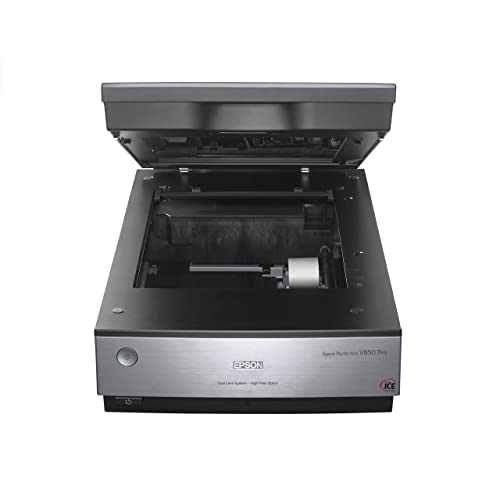
- 6400 dpi scanning resolution
- 4.0 Dmax for tonal and shadow detail
- Dual-lens system with Digital ICE
Best For: High-detail, quality-first photo scanning
Fast Photo Digitizer

- Scans 4x6 photos in about two seconds at 300 dpi
- Supports common photo sizes through 8x10
- Includes one-click image enhancement tools
Best For: High-volume digitizing of loose standard-size prints
Portable Studio Utility

- Compact USB-powered design weighs three ounces
- Scans photos and documents at up to 15 ppm
- Includes HP WorkScan editing and optimization tools
Best For: Portable mixed-media scanning and small batches
High-Detail Flatbed

- Provides 4800 dpi optical resolution
- Scans photos, artwork, books, and documents
- Includes one-click Easy Photo Fix restoration
Best For: Detailed flatbed scans of photos and artwork
Best Restoration Flatbed

- 4800 dpi optical resolution for detailed enlargements
- One-click Easy Photo Fix restores faded colors
- Removable lid supports thicker originals and books
Best For: Studios prioritizing detailed individual scans
Best Compact Detail Scanner

- 4800 x 4800 dpi resolution for detailed photos
- USB Type-C carries both power and data
- Slim flatbed includes dust and color enhancements
Best For: Small studios with limited workspace
Best High-Volume Photo Scanner – Epson FastFoto FF-680W
For studios digitizing large collections of prints, the Epson FastFoto FF-680W is one of the more practical photo scanners for photography studios. It can batch-scan up to 36 photos and reach speeds of up to one photo per second at 300 dpi, while wireless connectivity supports flexible placement.
Best For: Studios processing large batches of printed photos, postcards, panoramas, and documents.
Pros:
- Batch-scans up to 36 photos at a time.
- Supports 300 dpi sharing, 600 dpi TIFF archiving, and 1200 dpi enlargements.
- Includes automatic enhancement, color restoration, red-eye reduction, cropping, rotation, and de-skew.
- Duplex scanning captures handwritten notes on the backs of photos.
Cons:
- Designed for prints up to 8 x 10 inches rather than larger artwork.
- Its automatic document feeder workflow may be less suitable for highly delicate or irreplaceable originals, despite included SafeTouch features.
The FF-680W stands out when throughput and organization matter most. Its OCR, cloud backup options, carrier sheet, and wireless connection add useful studio workflow support, while the range of output resolutions provides flexibility for sharing or archiving.
Best Film and Slide Scanner – Magnasonic FS71 24MP
The Magnasonic FS71 is a compact choice for studios that need to convert film and slides without setting up a computer-based scanning workflow. It handles several film formats, saves 24MP JPEG files to an SD card, and completes scans in less than five seconds each.
Best For: Studios digitizing 35mm, 110, 126, Super 8 film, and 135, 126, or 110 slides.
Pros:
- Supports multiple film-negative and slide formats.
- Works without a computer or additional scanning software.
- Offers a 5-inch display and HDMI output for viewing on a TV or monitor.
- Provides brightness, RGB color correction, flip, and mirror controls on the scanner.
Cons:
- SD card is not included.
- Designed for film and slides rather than ordinary prints or batch document scanning.
- HDMI cable is not included.
For film-focused work, the FS71 keeps the process simple and portable. Its built-in controls and display are convenient for quick conversions, though studios requiring extensive editing, automated organization, or high-volume print scanning may need a more advanced system.
Best Connected Studio Scanner – ScanSnap iX2500 Photo Edition
The ScanSnap iX2500 Photo Edition suits photography studios that want fast scanning paired with streamlined file handling. Its 100-sheet document feeder, capacity for up to 36 photos, Wi-Fi 6, USB-C, touchscreen profiles, and cloud support make it useful for mixed photo and document workflows.
Best For: Studios that scan photos, documents, receipts, and business cards and want connected organization tools.
Pros:
- Scans up to 100 photos per minute according to the supplied product notes.
- Holds up to 100 documents or 36 photos in the feeder.
- Supports Wi-Fi 6, USB-C, mobile devices, PCs, Macs, and cloud services.
- Includes photo carrier sheets and automatic optimization, naming, and sorting features.
Cons:
- Requires relatively current operating systems and mobile platforms.
- Its workflow is optimized for prints and documents rather than listed film-negative formats.
The iX2500 is a strong all-around workflow option for studios balancing image intake with administrative scanning. Its touchscreen profiles and connectivity can reduce repetitive setup, while carrier sheets provide added support for delicate prints.
Best Detail-Focused Photo Scanner – Epson Perfection V850 Pro
The Epson Perfection V850 Pro is aimed at studios where scan quality and tonal detail take priority over high-volume feeder speed. Its 6400 dpi resolution, 4.0 Dmax tonal range, dual-lens system, and Digital ICE support make it a specialist option for demanding photo work.
Best For: Photography studios producing detailed scans of prints and other photo originals through a USB-connected workflow.
Pros:
- Offers 6400 dpi resolution for detailed scans.
- Provides a 4.0 Dmax tonal range for smooth gradations and shadow detail.
- Uses a dual-lens system to select the appropriate lens for scanning.
- Includes Digital ICE for the listed photo-scanning workflow.
Cons:
- USB connectivity limits placement compared with wireless models.
- At 20.9 pounds, it is relatively heavy for a studio scanner.
- The supplied operating-system list is older than the requirements listed for newer models.
The V850 Pro is best considered a quality-first flatbed-style tool rather than a rapid batch scanner. Its high resolution, tonal range, and dual-lens design make it appealing when preserving fine detail and shadow information is more important than maximizing throughput.
Fast Photo Digitizer – Plustek ePhoto Z300
For photography studios processing large batches of prints, the Plustek ePhoto Z300 is a streamlined choice among photo scanners for photography studios. Its sheetfed design handles common photo sizes from 3×5 through 8×10, with a stated scan time of about two seconds for a 4×6 photo at 300 dpi.
Best For: Studios digitizing large collections of standard-size prints quickly.
Pros:
- Scans 4×6 photos in about two seconds at 300 dpi and 8×10 photos in about five seconds.
- Supports 3×5, 4×6, 5×7, 8×10, letter, and A4 media.
- CCD sensor and up to 600 dpi optical resolution support detailed scans.
- Includes image-enhancement tools for restoring faded photos.
Cons:
- Uses a one-at-a-time feed with a standard sheet capacity of one.
- Listed minimum system requirements specify Windows 7, with no Mac compatibility noted.
The Z300 prioritizes throughput and simple operation over flatbed versatility. It is especially practical when a studio has many loose prints to digitize and wants to avoid repeatedly lifting a flatbed lid.
Portable Studio Utility – HPPS100 Mobile Scanner
The HPPS100 is a compact option for photography studios that need photo scanners for photography studios without adding bulky equipment. This USB-powered, single-sheet scanner handles photos and documents, making it useful for mobile work, intake stations, and smaller scanning batches.
Best For: Mobile studio workflows and mixed photo-and-document scanning.
Pros:
- Lightweight 3-ounce design and USB 2.0 connectivity suit portable use.
- Scans one-sided pages at up to 15 pages per minute.
- Accepts media from 2 x 2.9 inches up to 8.5 x 14 inches, including photos and receipts.
- HP WorkScan software offers auto-scan, size detection, cropping, editing, and image optimization.
Cons:
- Its listed resolution is 300 dpi, below the resolution of dedicated high-detail flatbed models.
- Single-sided, single-sheet operation is less suited to large photo batches.
The HPPS100 is more of a flexible mobile scanner than a specialized archival photo unit. Choose it when portability, straightforward software, and mixed-media capability matter more than maximum photo detail or batch capacity.
High-Detail Flatbed – Epson Perfection V19 II
For studios that value image detail and flexible placement, the Epson Perfection V19 II is a strong candidate among photo scanners for photography studios. Its flatbed design provides 4800 dpi optical resolution and accommodates photos, artwork, books, and documents up to 8.5 x 11.7 inches.
Best For: Detailed scans of prints, artwork, and items that benefit from flatbed handling.
Pros:
- 4800 dpi optical resolution supports detailed photo scans and enlargements.
- Flatbed surface scans photos, artwork, illustrations, books, and documents.
- Easy Photo Fix restores color to faded photos with one click.
- Removable high-rise lid helps accommodate thicker materials and pages.
Cons:
- Flatbed operation requires placing items individually, which can be slower for large print collections.
- Standard sheet capacity is one.
The V19 II is the better fit when scan quality and versatility outweigh batch speed. Its flatbed platform is also more appropriate for delicate originals, artwork, and bound materials than a sheetfed photo scanner.
Best High-Volume Pick – Canon imageFORMULA RS40
For photography studios seeking photo scanners for photography studios that can handle batches efficiently, the Canon imageFORMULA RS40 combines an automatic feeder with fast duplex scanning. It supports varied media, including photos, Polaroids, cards, receipts, and documents.
Best For: Studios digitizing mixed photo and document batches with minimal manual handling.
Pros:
- Scans both sides simultaneously at up to 40 items per minute.
- 60-sheet standard capacity supports longer scanning sessions.
- Bundled software includes photo enhancement, red-eye correction, and face smoothing.
- Works with Windows and Mac and saves to formats including JPG, TIF, PNG, and PDF.
Cons:
- Its automatic-feeder design is less suited to delicate originals requiring flatbed placement.
- Maximum listed resolution is 600 dpi, with 1200 dpi identified as interpolated.
The RS40 is the most workflow-oriented option here. Choose it when throughput and flexible media handling matter more than flatbed-style control over individual photographs.
Best Restoration Flatbed – Epson Perfection V39 II
The Epson Perfection V39 II is a practical choice among photo scanners for photography studios when image detail and restoration are priorities. Its flatbed design supports photos, artwork, books, and documents, while 4800 dpi optical resolution is suited to enlargements.
Best For: Studios scanning individual photographs, artwork, and oversized originals with detailed output.
Pros:
- 4800 dpi optical resolution supports detailed scans and enlargements.
- Easy Photo Fix restores color to faded photos with one click.
- Removable high-rise lid accommodates thicker materials and pages.
- Can stitch oversized images together and send scans to cloud services with Epson ScanSmart.
Cons:
- Single-item flatbed scanning requires more hands-on placement than an automatic feeder.
- The supplied specifications list a 300 dpi resolution setting despite the 4800 dpi optical-resolution claim.
For careful, one-at-a-time scanning, the V39 II offers useful restoration and high-resolution capabilities in a compact, USB-powered design. It is better suited to image quality and flexibility than rapid batch production.
Best Compact Detail Scanner – Canon CanoScan LiDE 400
Canon CanoScan LiDE 400 Slim Scanner, 7.7" x 14.5" x 0.4", Document & Photo Scanner, Black
Check Price On AmazonThe Canon CanoScan LiDE 400 is a slim flatbed option for photography studios that need detailed photo scans without taking up much workspace. It combines 4800 x 4800 dpi resolution with one-cable USB Type-C data and power connectivity.
Best For: Small studios needing a portable, space-saving scanner for photos and letter-size documents.
Pros:
- 4800 x 4800 dpi resolution preserves fine image detail.
- Color restore and dust-removal enhancements help improve scanned photos.
- One-cable USB Type-C connection supplies both data and power.
- EZ Buttons and Auto Scan mode simplify routine operation.
Cons:
- Single-sheet flatbed operation is less efficient for large batches.
- The slim design is intended for letter-size and photo media rather than varied oversized materials.
The LiDE 400 is a strong fit when desk space, portability, and detailed flatbed scans are key considerations. Its single-item workflow makes it more appropriate for selective scanning than high-volume archival work.
How We Picked the Best Photo Scanners for Photography Studios
We evaluated these models for the demands of studio digitization: image quality, scanning speed, supported media, paper-handling flexibility, software compatibility, and ease of organizing large batches. We also considered whether each scanner is best suited to prints, documents, negatives, slides, or a mixture of source materials.
Resolution numbers are only part of the picture. A dependable scanner should produce clean, color-consistent files, preserve fine detail, and fit the studio’s daily workflow. Automatic feeding, dust and scratch correction, wireless connectivity, and bundled software can be especially valuable when processing hundreds or thousands of images.
Quick Comparison
| Best For | Scanner Type | What to Prioritize |
|---|---|---|
| Large print archives | High-speed sheetfed | Automatic feeding and batch software |
| Fine-art and professional reproduction | Flatbed | High optical resolution and accurate color |
| Negatives and slides | Film scanner | Supported film formats and dust reduction |
| Mixed photo and document work | Photo/document scanner | Media flexibility and reliable feeding |
| Small studios or mobile work | Compact USB scanner | Low footprint and simple setup |
Key Buying Factors for Photo Scanners for Photography Studios
Optical Resolution and Image Quality
Choose optical resolution rather than an interpolated figure. Around 600 dpi is often sufficient for everyday photo archiving, while 1200 dpi or higher is more useful for enlargements, detailed restoration, and professional reproduction. A quality CCD or dual-lens system can also help with tonal transitions and edge detail.
Throughput and Batch Handling
Studios digitizing boxes of prints should look for an automatic document feeder, duplex capability where relevant, and software that can separate, rotate, crop, and name files. Flatbeds are slower but better for fragile, thick, or irregular originals.
Film Support and Restoration Tools
If your archive includes negatives or slides, verify the exact supported formats before buying. Digital ICE or comparable correction can reduce dust and scratch cleanup, but it does not replace careful handling and proper exposure settings.
Connectivity and File Workflow
USB is dependable for a dedicated workstation, while Wi-Fi can simplify shared studio use. Check operating-system support, included drivers, color-management options, and whether the scanner exports the file types your editing and archive systems require.
Who Should Buy Which Photo Scanners for Photography Studios?
Choose a high-speed sheetfed model if your priority is processing large stacks of standard prints quickly. Select a professional flatbed when maximum control, color fidelity, and compatibility with delicate originals matter more than speed. A dedicated film scanner is the better fit for studios whose main archive is 35mm, 110, 126, or slide film.
For mixed client paperwork and photo batches, a versatile photo/document scanner offers the most practical balance. Compact USB flatbeds make sense for smaller studios, backup stations, and occasional scanning, especially when desk space and budget are limited. Before ordering, confirm the scanner’s maximum media size, feeder limitations, software compatibility, and expected monthly workload.