Preserving film takes more than a basic document scanner. The best high-resolution film scanners are designed for negatives and slides, combining detailed capture with features such as infrared dust removal, calibrated color, and convenient batch workflows.
This roundup compares 10 options for different needs, from straightforward 35mm scanning to premium flatbed systems for mixed originals, prints, and enlargements.
Best 10 High Resolution Film Scanners Picks for 2026
Best for Easy Home Scanning
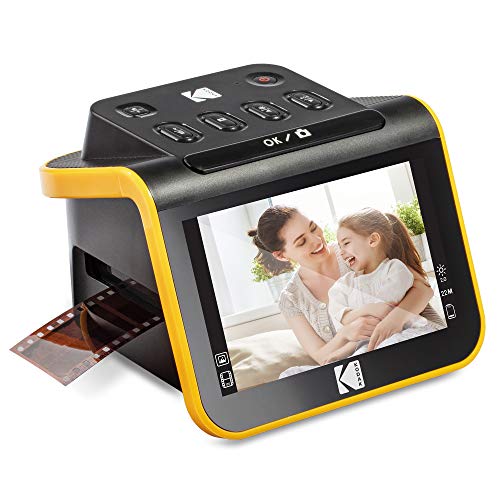
- 22MP capture and 5-inch LCD
- Supports 135, 110, and 126 formats
- Scans save directly to SD or SDHC
Best For: Casual home digitizing of mixed-format film
Best for Modern 35mm Workflows

- 7200 dpi and 48-bit color depth
- Includes SilverFast Ai Studio and IT8 target
- Batch scans slides and film frames
Best For: Detailed, calibration-focused 35mm scanning
Best for Professional Photo Scanning
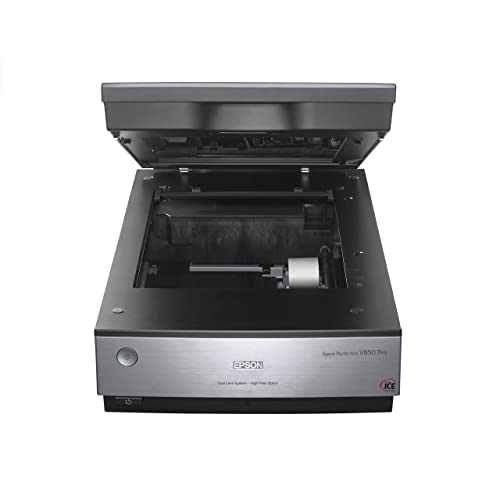
- 6400 dpi film-scanning resolution
- 4.0 Dmax for shadow detail
- Dual-lens system with Digital ICE
Best For: Demanding film and photo digitization
Best for Calibrated 35mm Archiving
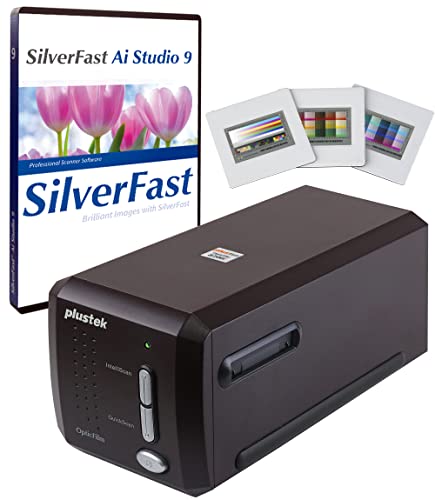
- 7200 dpi 35mm scanning
- Includes Advanced IT8 calibration target
- SilverFast 9 with infrared and HDRi tools
Best For: Advanced, repeatable 35mm archiving
Best High-Resolution Flatbed

- 6400 x 9600 dpi maximum resolution
- Supports 35mm and medium-format film
- Includes DIGITAL ICE restoration tools
Best For: Detailed film, slide, photo, and document scanning
Best Standalone 24MP Option

- Produces 24MP JPEG files
- Works without a computer
- Includes a 5-inch display and HDMI output
Best For: Quick, simple digitization of common film formats
Best Touchscreen Film Scanner
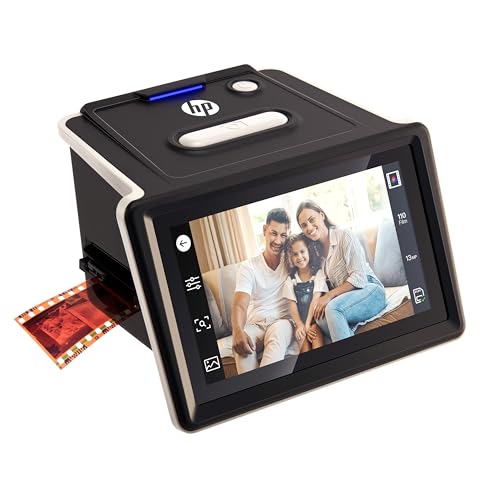
- 13MP sensor with 22MP interpolation
- 5-inch touchscreen controls
- Quick-load tray for batch scanning
Best For: Standalone scanning of mixed 135, 126, and 110 film
Best High-Resolution Choice

- 7200 dpi, 48-bit scanning for 35mm film
- Infrared dust and scratch detection
- Includes SilverFast SE Plus 9
Best For: Detailed 35mm negative and slide scanning
Best for Easy Home Archiving

- Handles 135mm, 110, and 126mm film
- Saves directly to SD/SDHC cards
- Large 7-inch tiltable LCD
Best For: Convenient mixed-format family archives
Best Multi-Format Value
KODAK SCANZA Film & Slide Scanner
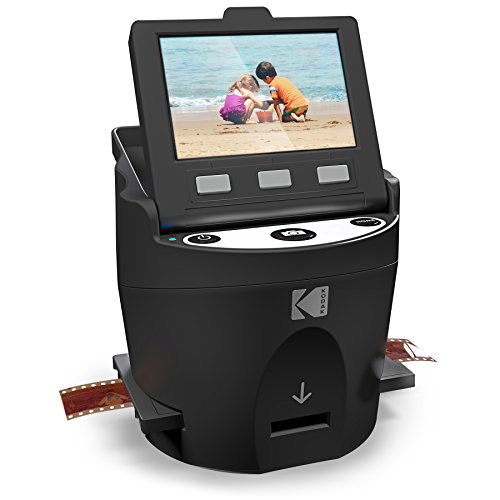
- Supports five listed film formats
- 14MP/22MP JPEG scanning
- Includes adapters and cleaning brush
Best For: Mixed-format collections and quick JPEG archives
Best for Easy Home Scanning – KODAK Slide N Scan
If you want a straightforward option among high resolution film scanners, the KODAK Slide N Scan combines 22MP capture with a built-in 5-inch LCD. It supports 135, 110, and 126 negatives, plus 50mm, 135, 110, and 126 slides, and saves scans to an SD or SDHC card.
Best For: Families and casual users digitizing mixed-format slides and negatives without a computer during scanning.
Pros:
- 22MP capture with a large 5-inch LCD for previewing and gallery viewing.
- Supports several common film and slide formats, including 135, 110, and 126.
- Includes film adapters, a cleaning brush, USB cable, and HDMI cable.
- Offers one-touch editing for color, brightness, size, and date/time adjustments.
Cons:
- SD or SDHC card is required but not included.
- Its listed 24-bit color depth is less specialized than the deeper color specifications of professional film scanners.
- Panoramic and specialty professional workflows are not indicated in the supplied specifications.
The KODAK is a convenient choice when speed, simple controls, and broad format support matter more than advanced calibration. Its screen and direct-to-card workflow make it especially approachable for home archives.
Best for Modern 35mm Workflows – Plustek OpticFilm 135i Ai
The Plustek OpticFilm 135i Ai is a high resolution film scanner for users who want detailed 35mm scans and a more controlled editing workflow. Its 7200 dpi resolution, 48-bit color depth, SilverFast Ai Studio software, and Advanced IT8 target support calibration-focused work.
Best For: Photographers and serious archivists scanning 35mm slides, negatives, half-frame images, and selected panoramic formats.
Pros:
- 7200 dpi resolution and 48-bit color depth support detailed scans and tonal information.
- Third-generation five-element lens is designed to improve edge stability and reduce refraction.
- Infrared quality enhancements support dust and scratch detection with iSRD workflows.
- Batch scanning accommodates four slides or six film frames at once.
Cons:
- Panoramic film holder is optional.
- Requires Windows 10 or later or macOS 10.15 or later.
- USB connectivity requires a computer-based workflow rather than direct memory-card saving.
With its high resolution, bundled calibration target, and productivity-oriented holders, the 135i Ai is aimed at users who want more control than a basic consumer scanner. It is a strong fit for organized 35mm digitization projects.
Best for Professional Photo Scanning – Epson Perfection V850 Pro
The Epson Perfection V850 Pro is a high resolution film scanner and photo scanner built for demanding image work. Its 6400 dpi resolution, 4.0 Dmax tonal range, dual-lens system, and Digital ICE are designed to preserve fine detail, shadow information, and smooth gradations.
Best For: Photographers and studios scanning film and photo originals where tonal range and detailed output are priorities.
Pros:
- 6400 dpi resolution targets fine detail in film and photographic originals.
- 4.0 Dmax supports smooth gradations and shadow detail.
- Dual-lens design selects a lens for the scanning resolution being used.
- CCD sensor and Digital ICE support a more professional scanning setup.
Cons:
- At 20.9 pounds, it is substantially less portable than dedicated compact film scanners.
- Uses a USB computer connection and does not list direct-to-card scanning.
- The supplied operating-system list is centered on older Windows and Mac OS versions.
The V850 Pro makes the most sense when image quality and tonal handling outweigh size or simplicity. Its flatbed format can also be useful for users who need a more versatile photo-scanning setup than a film-only unit.
Best for Calibrated 35mm Archiving – Plustek OpticFilm 8300i Ai
The Plustek OpticFilm 8300i Ai is a high resolution film scanner designed for detailed 35mm slide and film archiving. It combines 7200 dpi resolution with SilverFast 9 Ai Studio, infrared-based processing, HDRi, Multi-Exposure, NegaFix, and an included Advanced IT8 target.
Best For: 35mm photographers and archivists who want calibration tools and advanced software for repeatable scanning.
Pros:
- 7200 dpi resolution is suited to detailed 35mm scans.
- Advanced IT8 target supports color calibration with additional measurement points.
- SilverFast 9 Ai Studio and Quick Scan Plus provide extensive processing options.
- Infrared iSRD, HDRi, Multi-Exposure, and NegaFix support specialized film workflows.
Cons:
- Designed for 35mm slides and film rather than a broad range of film formats.
- Its extensive software feature set may require more time to learn than one-touch scanners.
- USB computer connectivity is required.
The 8300i Ai is a focused choice for serious 35mm preservation. Its included calibration target and advanced software make it particularly compelling when consistent color and restoration-oriented controls are more important than scanning convenience.
Best High-Resolution Flatbed – Epson Perfection V600 Photo
For buyers seeking high resolution film scanners with flexible media support, the Epson Perfection V600 is a strong flatbed option. Its 6400 x 9600 dpi maximum resolution, built-in transparency unit, and support for 35mm and medium-format film make it suited to detailed archival work and enlargements.
Best For: Digitizing 35mm negatives, mounted slides, medium-format film, photos, and documents with a computer-based workflow.
Pros:
- 6400 x 9600 dpi resolution supports enlargements up to 17 x 22 inches.
- Scans four mounted 35mm slides, 12 negatives, or medium-format film up to 6 x 22 cm.
- Includes DIGITAL ICE for dust and scratch removal, plus faded-image restoration tools.
- ReadyScan LED technology operates without a warm-up period.
Cons:
- Uses wired Hi-Speed USB 2.0 connectivity.
- Its flatbed design is larger and heavier than compact standalone film scanners.
- Requires a computer and compatible software for scanning.
The V600 is the most versatile choice here for users who prioritize optical resolution, medium-format compatibility, and restoration features over portability.
Best Standalone 24MP Option – Magnasonic FS71 Film Scanner
The Magnasonic FS71 is a convenient pick among high resolution film scanners for users who want quick, computer-free digitization. It converts several common film and slide formats into 24MP JPEG files and includes a large display for previewing and adjusting images directly on the unit.
Best For: Fast home scanning of 35mm, 110, 126, Super 8 film, and 135, 126, and 110 slides without installing computer software.
Pros:
- Converts supported film and slides into 24MP digital JPEG files.
- Standalone operation requires no computer, drivers, or photo-editing software.
- 5-inch LCD screen supports previewing and image adjustments.
- Scans photos in less than five seconds each and saves them to an SD card up to 128GB.
Cons:
- SD card is not included.
- HDMI cable for TV or monitor viewing is not included.
- Its 24-bit color depth and fixed scanning workflow offer less flexibility than a high-resolution flatbed.
Choose the FS71 when speed, simple controls, and standalone convenience matter more than advanced computer-based editing or medium-format support.
Best Touchscreen Film Scanner – HP FilmScan HPFS500
The HP FilmScan HPFS500 offers a straightforward standalone approach to high resolution film scanners. Its 13MP CMOS sensor with 22MP interpolation, 5-inch touchscreen, and support for 135, 126, and 110 formats make it practical for scanning mixed collections without a computer.
Best For: Digitizing mixed 135, 126, and 110 negatives and positive slides with touchscreen controls and a quick-load workflow.
Pros:
- Standalone design digitizes film without requiring a computer.
- 5-inch all-angle LCD touchscreen enables direct preview and editing.
- Supports 135, 126, and 110 negatives and positive slides.
- Quick-load tray helps speed up batch scanning.
Cons:
- Its 13MP sensor relies on interpolation to reach 22MP output.
- Supports fewer film formats than the Magnasonic FS71.
- Requires an SD card for media storage, and the supplied notes do not indicate that one is included.
The HPFS500 is a practical choice for casual archivists who value a touchscreen interface, standalone use, and faster handling of mixed-format film collections.
Best High-Resolution Choice – Plustek OpticFilm 8200i SE
For photographers seeking high resolution film scanners for 35mm negatives and mounted slides, the Plustek OpticFilm 8200i SE emphasizes detailed output with 7200 dpi resolution and 48-bit color support. Its infrared dust and scratch detection can reduce the need for manual retouching.
Best For: 35mm film users who prioritize resolution, color depth, and automated defect removal.
Pros:
- 7200 dpi scanning delivers up to 69-megapixel output for 35mm film.
- Built-in infrared dust and scratch detection helps clean up scans.
- Includes SilverFast SE Plus 9 and Plustek QuickScan software.
- Supports Windows 7 through 11 and Mac OS 10.7 through 14.x.
Cons:
- Designed for 35mm negatives and mounted slides rather than multiple film formats.
- Requires a USB connection and computer-based workflow.
The OpticFilm 8200i SE is the strongest fit here for detail-focused 35mm archiving. Its specialized format support and computer workflow make it less flexible than standalone multi-format scanners, but the resolution and infrared channel are valuable for demanding scans.
Best for Easy Home Archiving – KODAK Slide N Scan Max
The KODAK Slide N Scan Max is a practical option for shoppers comparing high resolution film scanners for convenient home digitizing. Its 7-inch tiltable LCD, quick-feeding tray, and direct SD card saving help simplify scanning without requiring a computer for every session.
Best For: Families and casual archivists digitizing mixed 135mm, 110, and 126 film collections.
Pros:
- Supports 135mm, 110, and 126mm negatives and slides.
- 3200 dpi resolution provides a straightforward digital conversion workflow.
- Saves scans directly to SD or SDHC cards up to 32GB.
- 7-inch tiltable LCD supports previewing, editing, and viewing scans.
Cons:
- Its 24-bit color depth is lower than the Plustek’s 48-bit specification.
- SD/SDHC card storage is limited to cards up to 32GB.
Choose the Slide N Scan Max when ease of use and format flexibility matter more than maximum capture specifications. The standalone SD workflow and large display make it approachable for household archives, while 3200 dpi keeps it suitable for everyday sharing and preservation.
Best Multi-Format Value – KODAK SCANZA Film & Slide Scanner
For buyers who need high resolution film scanners with broad format support, the KODAK SCANZA converts 35mm, 126, 110, Super 8, and 8mm negatives and slides to JPEG files. Multiple inserts, one-touch controls, and a built-in display make it suited to hands-on home scanning.
Best For: Users with varied film formats who want quick JPEG scans and included adapters.
Pros:
- Supports 35mm, 126, 110, Super 8, and 8mm negatives and slides.
- Offers 14MP and 22MP scan modes for JPEG conversion.
- Includes multiple film inserts, adapters, and a cleaning brush.
- Its 3.5-inch adjustable TFT LCD and one-touch buttons simplify operation.
Cons:
- Stores scans on an SD card, which is not included.
- Uses 24-bit color output rather than 48-bit output.
- The supplied notes specify support for Windows 7 and do not list newer operating systems.
The SCANZA stands out for format versatility and included accessories. It is a sensible choice for mixed collections and quick JPEG archiving, though users seeking the deepest color workflow or specialized 35mm detail may prefer a more dedicated scanner.
How We Picked the Best High Resolution Film Scanners
We evaluated these scanners by looking at supported film formats, advertised optical resolution, color depth, dust and scratch handling, connectivity, scanning workflow, and overall suitability for different archives. We also considered whether a model is best for occasional home use, regular 35mm scanning, or demanding photo restoration.
Advertised resolution is only one part of image quality. A scanner’s optics, sensor, software, film holder, and color management can affect the final file just as much as the headline dpi rating. For that reason, the list includes both dedicated film scanners and flatbed models with film capabilities.
Quick Comparison
- Fast, simple conversions: KODAK Slide N Scan, KODAK Slide N Scan Max, KODAK SCANZA, Magnasonic, and HP Film & Slide Scanner.
- Dedicated 35mm detail: Plustek OpticFilm 135i Ai, OpticFilm 8300i Ai, and OpticFilm 8200i SE.
- Flexible archival scanning: Epson Perfection V850 Pro and Epson Perfection V600 Photo.
- Best format coverage: Choose a model supporting the exact film types in your collection, especially 110, 126, Super 8, or 8mm.
Key Buying Factors for High-Resolution Film Scanners
Resolution and File Detail
Look for genuine optical resolution rather than relying only on interpolated numbers. Dedicated 35mm scanners generally offer stronger detail for enlargements, while flatbeds provide greater flexibility for prints and larger originals.
Film Formats and Holders
Check compatibility before buying. Some models focus on 35mm negatives and slides, while others also accept 110, 126, Super 8, or 8mm film. Included holders can also affect alignment, speed, and ease of use.
Dust Removal and Color Control
Infrared cleaning, Digital ICE, IT8 calibration, and bundled scanning software can reduce restoration work and improve consistency. These features matter most when digitizing valuable or heavily used film.
Workflow and Output
LCD previews, HDMI, USB connectivity, batch scanning, and standalone operation make casual scanning easier. For archival projects, prioritize high-bit-depth files, reliable software, and flexible color correction over convenience features alone.
Who Should Buy Which High Resolution Film Scanners?
Choose a KODAK, Magnasonic, or HP model if you want quick, approachable transfers for sharing and everyday family archives. These are convenient choices when speed and broad format support matter more than maximum editing latitude.
Choose a Plustek OpticFilm model if your collection is primarily 35mm and you want sharper scans, stronger control, and more serious restoration tools. The OpticFilm 135i Ai is suited to ongoing scanning, while the 8300i Ai and 8200i SE target detailed 35mm workflows.
Choose the Epson V850 Pro for demanding archival work and the V600 Photo for a more flexible, lower-cost flatbed approach. Either is worth considering if you need to scan prints alongside film, but confirm the included accessories and software meet your workflow requirements before purchase.