The sewing industry spans consumer sewing (home machines and DIY), industrial garment production, and the textile raw materials that feed it. Below are the most cited 2024–2026 numbers shaping the market right now.
sewing industry statistics
Key sewing industry statistics
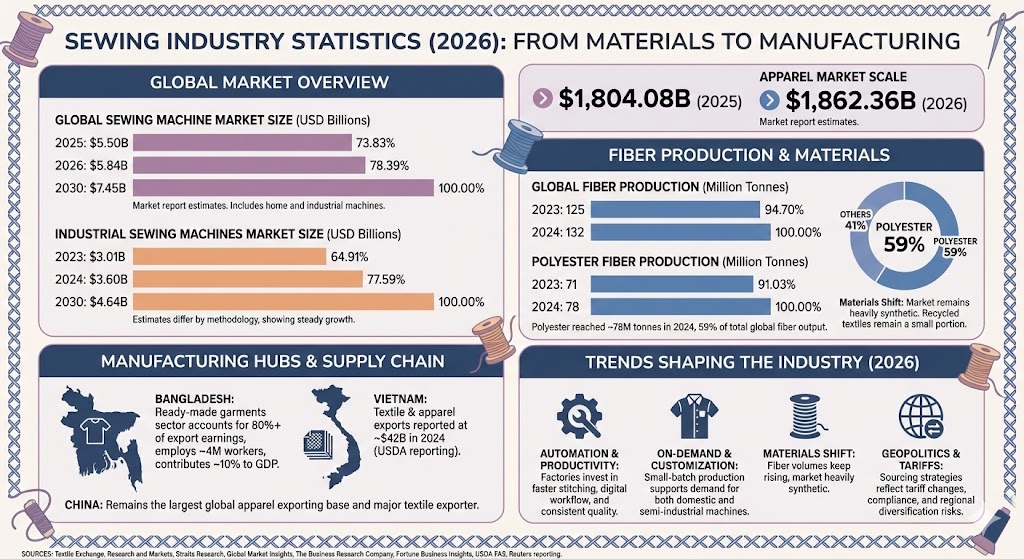
Global sewing machine market: estimated $5.84B in 2026, projected to reach $7.45B by 2030 (market report estimates).
Industrial sewing machines market: valued around $3.01B in 2023; estimates place it near $3.6B in 2024 and about $4.64B by 2030.
Apparel market scale: valued at $1,804.08B in 2025 and projected at $1,862.36B in 2026 (market report estimates).
Global fiber production: increased from 125M tonnes (2023) to 132M tonnes (2024).
Polyester dominance: polyester reached about 78M tonnes in 2024 and accounted for 59% of total global fiber output.
Bangladesh apparel manufacturing footprint: the ready-made garments sector accounts for 80%+ of export earnings, employs about 4M workers, and contributes roughly 10% to GDP (reported in major financial press).
Vietnam textile & apparel exports: reported at about $42B in 2024 (USDA reporting).
Sewing machine market size
Home and industrial sewing machines benefit from DIY demand, customization, and factory automation. Market-size figures vary by methodology, but most forecasts point to steady single-digit growth through 2030.
Chart: Global Sewing Machine Market Size (USD Billions)
Year
Bar
Value
2025
$5.50B
2026
$5.84B
2030
$7.45B
Max = $7.45B. Widths: 2025 73.83%, 2026 78.39%, 2030 100.00%.
Industrial sewing machines and factory automation
Industrial sewing output is tied to garment exports, technical textiles, automotive upholstery, and speed/quality automation (cutting, stitching, inspection). Estimates differ by coverage (machine types, channels, and regions), but the growth trend is consistent.
Max = $4.64B. Widths: 2023 64.91%, 2024 77.59%, 2030 100.00%.
Materials that drive sewing output
Fabric availability and pricing are foundational to sewing—whether for mass manufacturing or home projects. Recent data shows fiber production continuing to rise, with synthetics (especially polyester) expanding fastest.
Chart: Global Fiber Production (Million Tonnes)
Year
Bar
Value
2023
125
2024
132
Max = 132 million tonnes. Widths: 2023 94.70%, 2024 100.00%.
Chart: Polyester Fiber Production (Million Tonnes)
Year
Bar
Value
2023
71
2024
78
Max = 78 million tonnes. Widths: 2023 91.03%, 2024 100.00%.
Trade, manufacturing hubs, and supply-chain concentration
Bangladesh: garment exports are a major pillar of the economy, with reporting commonly citing 80%+ of export earnings, about 4 million workers, and roughly 10% of GDP.
Vietnam: government-linked reporting cited by the USDA describes textile & apparel exports reaching about $42B in 2024.
China: remains the largest apparel exporting base globally in most trade summaries, and is also a major exporter of textiles used in regional supply chains.
Trends shaping the sewing industry in 2026
Automation & productivity: factories invest in faster stitching, digital workflow, and consistent quality to offset labor and lead-time pressure.
On-demand and customization: small-batch production (and maker culture) supports steady demand for both domestic and semi-industrial machines.
Materials shift: fiber volumes keep rising, and the market remains heavily synthetic; Textile Exchange notes recycled textiles remain a very small portion of total fiber output.
Geopolitics & tariffs: sourcing strategies increasingly reflect tariff changes, compliance, and regional diversification risks (notably in major garment-exporting countries).
Sources
Textile Exchange — Materials Market Report 2025 (global fiber production 2023–2024; polyester volume and share): https://textileexchange.org/knowledge-center/reports/materials-market-report-2025/
Research and Markets — Sewing Machine Market Report (market size estimates 2025–2030): https://www.researchandmarkets.com/reports/5751567/sewing-machine-market-report
The Business Research Company — Industrial Sewing Machines Market Report (2030 projection): https://www.thebusinessresearchcompany.com/report/industrial-sewing-machines-global-market-report
USDA FAS (GAIN) — Cotton and Products Annual, Vietnam (textile & apparel exports ~$42B in 2024): https://apps.fas.usda.gov/newgainapi/api/Report/DownloadReportByFileName?fileName=Cotton+and+Products+Annual_Hanoi_Vietnam_VM2025-0013.pdf
Reuters reporting on Bangladesh garments sector share of exports, employment, and GDP contribution (examples): https://www.reuters.com/world/asia-pacific/bangladesh-secures-19-us-tariff-exemption-some-apparel-made-with-us-material-2026-02-09/