If you need clean registration, faster setup, and dependable output across bigger batches, the right press can save hours on every run.
These picks focus on stability, usable print area, and features that matter when you’re handling screen printing presses for large projects.
Best 10 Screen Printing Presses for Large Projects Picks for 2026
Precision Multicolor Workhorse
6 Color 6 Station Press with Micro Registration

- 6-color, 6-station layout for multicolor work
- Micro-registration helps fine-tune alignment
- Reinforced steel plate and triangle support add stability
Best For: Multi-color garment printing with accurate registration
All-in-One Starter Bundle
6 Color 6 Station Press with Mesh Stretching Kit

- Press package includes mesh stretching tools
- Micro-adjust registration supports color matching
- Height-adjustable stand adds setup flexibility
Best For: Small shops wanting a bundled printing-and-prep solution
Large-Format Flatbed Choice
24x20 Inch Micro-Registration Screen Printer

- 24x20 platen suits larger flat substrates
- Micro-registration supports precise alignment
- Stable frame support helps with heavier screens
Best For: Oversized flat-stock jobs and hard-substrate printing
Expandable Large-Format Press
EQCOTWEA 24"x20" Screen Printing Press
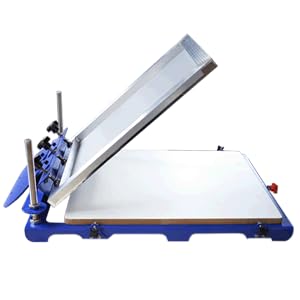
- 24" x 20" platen for large flat projects
- Adjustable gravity disc improves screen balance
- Platen can be expanded for bigger jobs
Best For: Large-format DIY and shop work on flat items
Production Floor Press
8 Color 8 Station Micro-Registration Press

- 8 color and 8 station layout for bigger runs
- Micro-registration helps with accurate alignment
- Heavy floor-standing build suits production spaces
Best For: Dedicated print shops needing high-capacity multi-color output
Bench-Mounted Multi-Color Press
VEVOR 4 Color 1 Station Screen Printing Press

- 4 color setup with 21.3 x 17.7 in print area
- 360° rotating body supports smoother positioning
- Powder-coated carbon steel for durability
Best For: Small businesses and DIY users printing flat items
Large-Run Manual Press
EQCOTWEA 6 Color 6 Station Manual Press
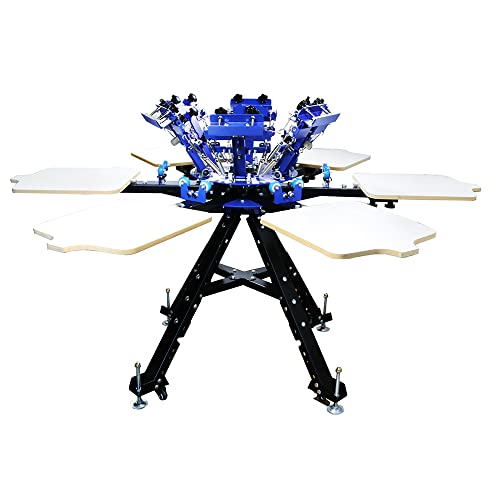
- 6-color, 6-station layout for multi-step jobs
- Micro-registration knobs for precise alignment
- Adjustable 23-43 inch stand for operator comfort
Best For: multi-color shops needing stable, repeatable registration
High-Volume Production Press
8 Color 8 Station Double Spring Press

- 8 stations help keep multi-color jobs moving
- Micro-adjust knobs on each holder improve alignment
- Two-person workflow targets 30-50 shirts per hour
Best For: higher-volume shops with space for a full production setup
Compact Multi-Use Press
VEVOR 4 Color 1 Station 360° Rotable Press

- Compact 1-station design fits smaller spaces
- 360° rotation and bearings support stable use
- Works on clothing and other flat materials
Best For: small shops or DIY users with limited workspace
Precision Multicolor Workhorse – 6 Color 6 Station Press with Micro Registration
If you’re comparing screen printing presses for large projects, this 6 color 6 station setup is built for higher-volume, multi-color work where alignment matters. The micro-registration system, independent screen and shirtboard rotation, and stable steel construction make it better suited to repeatable production than a basic entry-level press.
Best For: Multi-color t-shirt and textile printing where accurate registration and a more stable press are priorities.
Pros:
- Micro registration adjusts front, back, left, and right for more precise color alignment.
- Both shirtboard layer and screen layer can rotate independently for easier setup.
- All heads can be pressed down at the same time for multicolor printing on multiple stations.
- Thicker steel round plate and triangle support add stability during printing.
Cons:
- Manual press design still requires careful setup for accurate results.
- Best suited to flat garment and textile work rather than mixed-purpose use.
This model stands out for users who want smoother registration and sturdier support on larger, repeatable print runs. If your projects involve layered color work, the adjustable and reinforced design is the main advantage.
All-in-One Starter Bundle – 6 Color 6 Station Press with Mesh Stretching Kit
6 Color 6 Station Screen Printing Press & Mesh Stretching Pinting Kit - 006974
Check Price On AmazonFor buyers looking at screen printing presses for large projects, this package combines a 6 color 6 station press with a mesh stretching kit, so you get both the printing machine and part of the screen-prep workflow in one bundle. The micro-adjust registration and height-adjustable stand help make it more practical for colorful flat printing across a range of substrates.
Best For: Small businesses or individual users who want a press package with screen-stretching tools included.
Pros:
- Includes a 6 color 6 station manual press plus mesh stretching equipment.
- Micro-adjust handles help with left-right registration for color matching.
- Height-adjustable metal stand offers setup flexibility from 28″ to 35″.
- Works on many flat materials, including fabric, paper, plastic, wood, glass, and more.
Cons:
- Bundle is broad, so buyers mainly focused on the press alone may not need the extra kit.
- Best results still depend on careful setup and screen preparation.
This is a strong value-minded option if you want a more complete screen printing setup rather than just the press. The included stretching tools make it especially appealing for users building out a practical production workflow.
Large-Format Flatbed Choice – 24×20 Inch Micro-Registration Screen Printer
INTBUYING 24x20inch Screen Printing Machine with Micro-registration for PCB SMT T-Shirt DIY
Check Price On AmazonIf you need screen printing presses for large projects on oversized or hard substrates, this 24×20 inch machine is built around a bigger platen and a more stable printing process. Its micro-registration knobs and adjustable screen clamp height make it a practical choice for flat work on items like boards, cartons, glass, metal, and circuit boards.
Best For: Larger flat-stock printing jobs that need a bigger platen and fine registration control.
Pros:
- Bigger platen is suited to larger hard substrates and flat materials.
- Micro-registration knobs adjust left-right and front-back positioning.
- Gravity hole and sliding-adjustable disc help support heavier screen frames.
- High-density melamine platen is waterproof, corrosion-resistant, and easy to clean.
Cons:
- Screen frame is not included.
- Designed for flat substrates, so it is not a general-purpose printing system.
For oversized jobs, the bigger platen and added stability are the main reasons to consider this model. It is especially useful when the workpiece is larger than a standard garment platen can comfortably handle.
Compact Beginner Press – 1 Color 1 Station Screen Printer
This 1 color 1 station press is a simpler option for buyers who want to learn the basics before moving to screen printing presses for large projects. The hinge design, base groove alignment, and wood structure are aimed at making setup and operation easier for DIY garment printing and other small creative jobs.
Best For: Beginners who want a straightforward manual press for small-format t-shirt and DIY projects.
Pros:
- Unique hinge design lets the wood frame lift and hover for easier use.
- Base groove and centerline help with garment stability and alignment.
- Simple installation makes it approachable for new users.
- Wood structure is described as sturdy and durable.
Cons:
- 1 color, 1 station design is not intended for large multi-color production.
- Best suited to smaller DIY projects rather than higher-volume output.
As a beginner-friendly press, this model focuses on simplicity and control instead of production scale. It makes sense when you want an easier learning platform before upgrading to more advanced multi-station equipment.
Expandable Large-Format Press – EQCOTWEA 24"x20" Screen Printing Press
If you need screen printing presses for large projects, this EQCOTWEA flatbed stands out for its 24″ x 20″ platen and adjustable setup. It is built to handle oversized T-shirts, signage, boards, and other flat workpieces while keeping positioning adjustable for different material thicknesses.
Best For: Print shops, DIY users, and makers who want a larger platen and flexible expansion for oversized flat items.
Pros:
- Extra-large 24″ x 20″ printing surface suits large-format workpieces.
- Adjustable gravity disc helps balance screens of different sizes and weights.
- Vertical screw bar allows up to 4.3″ of adjustment for varying thicknesses.
- Platen can be swapped for a larger size as your production needs grow.
Cons:
- Single-station design limits output speed for multi-color production.
- Heavier, more substantial frame may be less convenient to move frequently.
Overall, this is a practical choice when the priority is a roomy platen and adaptable setup rather than high-volume multi-color throughput. The sturdy, rust-resistant build and easy-clean surface make it appealing for repeated use on bigger flat projects.
Production Floor Press – 8 Color 8 Station Micro-Registration Press
8 Color 8 Station Floor Type Micro-Registration Double Wheel Overprinting Screen Printing Press
Check Price On AmazonFor screen printing presses for large projects that need scale and flexibility, this floor-type model is designed around an 8 color, 8 station layout with micro-registration. Its split structure, heavy-duty build, and adjustable support system make it geared toward bigger production setups rather than compact hobby use.
Best For: High-output print shops and production environments that need multiple stations and color capability.
Pros:
- 8 color, 8 station layout supports larger, more complex production runs.
- Micro-registration and frame clamping help keep positioning stable and uniform.
- Support wheels and moving rollers make the machine adjustable and easier to move.
- Durable mixed-metal construction with corrosion-resistant finishes.
Cons:
- Very large and extremely heavy, so it is not suited to small workspaces.
- Floor-type setup is more appropriate for dedicated production areas than casual users.
This is the most production-oriented option in the group, with the capacity and stability features needed for more demanding workflows. If you need a long-term machine for serious volume and multi-color work, this model is built for that role.
Bench-Mounted Multi-Color Press – VEVOR 4 Color 1 Station Screen Printing Press
This VEVOR unit is a solid fit when you want screen printing presses for large projects in a more compact workbench format. With a 4 color, 1 station design and a 21.3 x 17.7 inch printing area, it supports multi-color work on flat materials without taking up floor-space like a larger production press.
Best For: DIY users and small businesses that want a stable, bench-mounted multi-color press for flat items.
Pros:
- 4 color, 1 station layout supports efficient color changes.
- 360° rotating body and bearings allow smoother operation and positioning.
- Positioning stop blocks under each arm help reduce deviation.
- Powder-coated carbon steel construction is built for wear resistance and durability.
Cons:
- Smaller printing area than larger floor-standing presses.
- Bench-mounted design may not fit every workspace or workflow.
For users who need multi-color flexibility more than raw production scale, this press offers a balanced mix of stability and versatility. It is well suited to flat materials like shirts, bags, fabric, paper, plastics, and more.
Large-Run Manual Press – EQCOTWEA 6 Color 6 Station Manual Press
If you’re comparing screen printing presses for large projects, this 6-color, 6-station manual press is built around repeatable registration and steady production. The 360° rotating pallets and screen frames, plus the fine-tuning knobs on each arm, are designed to help you line up multi-color jobs efficiently.
Best For: Shops or serious hobbyists who need accurate multi-color printing with a height-adjustable workstation for longer runs.
Pros:
- Independent 360° rotation for both pallets and screen frames supports smoother workflow.
- Three fine-tuning knobs per frame allow ±0.6 inches of micro-adjustment for registration.
- Adjustable stand height from 23 to 43 inches helps reduce fatigue during long sessions.
- Includes 6 large 22 x 18 inch melamine pallets with a matte micro-pitted surface for better adhesive grip.
Cons:
- At 316 pounds, it is a heavy machine that will take planning to move and set up.
- Its size and station count make it better suited to larger workspaces than compact setups.
This press is strongest when accuracy and consistency matter more than portability. The locking system, adjustable spring tension, and stable pallet construction make it a practical choice for repeatable multi-color work.
High-Volume Production Press – 8 Color 8 Station Double Spring Press
For buyers looking at screen printing presses for large projects, this 8-color, 8-station press is aimed at higher-volume manual production. It combines 360-degree rotation, micro-adjusting chucks, and an 8-station layout so multiple screens can stay set up while you move through shirts efficiently.
Best For: Two-person production setups that want higher throughput and detailed micro-registration for multi-color prints.
Pros:
- 8-color, 8-station format supports larger production workflows.
- Independent 360° rotation on both pallet and screen frame improves access and setup.
- Eight micro-adjust knobs per holder make front-to-back and left-to-right correction easier.
- Claims 30-50 six-color shirts per hour with two people and a flash dryer.
Cons:
- Large footprint and 353 lb net weight mean it needs substantial floor space and setup effort.
- Designed for two-person use, so it may be less convenient for solo operators.
This machine is built more for output than portability. If you need a manual press that can stay dialed in across multiple stations, its adjustable supports and micro-registration system are the main reasons to consider it.
Compact Multi-Use Press – VEVOR 4 Color 1 Station 360° Rotable Press
If your version of screen printing presses for large projects still needs to fit a smaller workspace, this 4-color, 1-station press offers a compact way to handle multi-color printing. Its 360° rotable frame, metal bearings, and double-layer positioning pallet are aimed at keeping setup stable without taking up much room.
Best For: Home users, small businesses, and DIY printers who want a compact press for flat-substrate printing.
Pros:
- Compact 4-color, 1-station design is suited to limited-space setups.
- 360° rotation with independent metal bearings supports stable operation.
- Double-layer positioning design helps reduce deviation during printing.
- Built from cold-rolled steel with carbon steel spring and 304 stainless steel rod for durability.
Cons:
- Only one station, so it is less efficient for high-throughput large projects.
- Fewer color stations than larger production presses.
This is the most space-conscious option in the group, but it is also the least suited to high-volume output. It makes sense if you want versatility across flat materials while keeping the press footprint manageable.
How We Picked the Best Screen Printing Presses for Large Projects
We focused on presses that offer the best mix of build stability, registration control, print size, and station count for larger production runs. For Screen Printing Presses for Large Projects, consistency matters more than flashy extras, so we favored models that should help reduce misalignment and rework.
Quick Comparison
In general, 1-station presses work well for compact workspaces and slower, controlled production, while 4-color and 6-color units offer a strong balance for small business use. 8-station presses are the better fit when you need to move through more screens, colors, or repeated setups with less downtime.
Key Buying Factors for Screen Printing Presses for Large Projects
Registration and Alignment
Micro-registration is one of the most useful features for larger jobs because it helps keep layers aligned across repeated prints. If you plan to print multicolor artwork or long runs, look for fine adjustment controls rather than basic lock-and-place setups.
Print Area and Material Support
Check the platen size against the items you print most often. Larger platens are better for adult apparel, signage, and flat substrates, while smaller presses may be more limiting even if they are easier to handle.
Stability and Frame Design
A heavier frame, floor-mounted base, or reinforced support structure can improve repeatability during high-volume work. Stability becomes especially important when you’re printing many items in one session or using larger screens.
Workflow and Station Layout
More stations can speed up production by letting you prepare multiple screens or colors at once. That said, the right number of stations depends on your shop space, your team size, and how often you switch designs.
Who Should Buy Which Screen Printing Presses for Large Projects?
If you’re a solo maker or running a small home setup, a 1-station or compact 4-color press may be enough. If you’re printing for a growing shop, team events, or steady side-business orders, a 6-color press is often the sweet spot for capacity and flexibility. For higher throughput, larger jobs, or more complex multicolor workflows, an 8-station model is the strongest choice.
Choose the largest press you can support comfortably in your workspace, but prioritize registration accuracy and structural rigidity first. Those are the features that have the biggest impact on real-world results.