Preserving printed photos takes more than choosing the highest advertised resolution. The right scanner balances image quality, restoration tools, speed, workflow, and compatibility with the kinds of photos or film you actually own.
We selected 10 standout options for everything from careful flatbed scanning to fast batch digitization, including models with Digital ICE and comparable dust- and scratch-reduction features.
Best 10 Photo Scanners with Digital Ice Picks for 2026
Professional Detail Pick
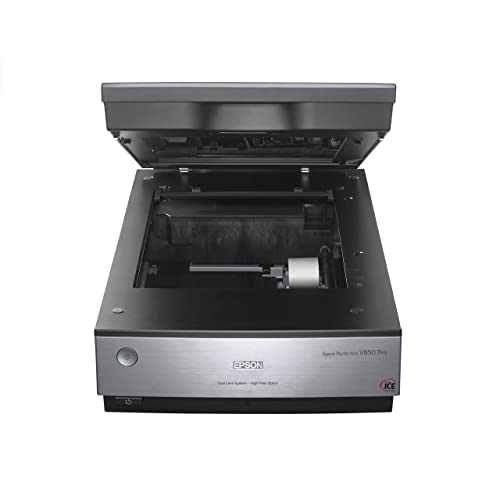
- 6400 dpi resolution and 4.0 Dmax
- Dual-lens CCD scanning system
- Digital ICE for photo restoration
Best For: High-detail photo archiving and professional scanning
Easy Batch Digitizer

- Scans 4x6 photos in about two seconds
- Supports photos up to 8x10
- Includes faded-image enhancement tools
Best For: Fast, simple home photo digitization
High-Volume Family Archive

- Batch-scans up to 36 photos
- About one photo per second at 300 dpi
- Wireless scanning with automatic corrections
Best For: Digitizing thousands of family photos quickly
Standalone Film Converter

- Converts several film and slide formats
- 24MP JPEG output to an SD card
- 5-inch display and no computer required
Best For: Simple, standalone film and slide digitizing
High-Resolution Choice
Epson Perfection V800 Photo Scanner

- 6400 dpi resolution for detailed scans
- 4.0 Dmax supports fine shadow detail
- Dual-lens system for photo and slide scanning
Best For: Archival photo and slide scanning with an emphasis on image quality
Compact Restoration Pick
Epson Perfection V19 II Photo Scanner

- 4800 dpi optical resolution for detailed scans
- Easy Photo Fix restores faded photo color
- Compact, lightweight, and USB-powered
Best For: Simple home scanning and restoring individual faded photos
Best Wireless Photo Scanner

- Scans up to 100 photos per minute
- Includes three photo carrier sheets
- Wi-Fi 6, USB-C, and cloud support
Best For: Fast, connected photo and document scanning
Best Digital ICE Photo Scanner

- Includes DIGITAL ICE dust-and-scratch removal
- Scans slides, negatives, film, and prints
- Up to 6400 x 9600 dpi resolution
Best For: High-resolution film and photo restoration
Best Portable Photo Scanner

- Weighs just 3 ounces
- USB-powered sheetfed scanning
- Includes HP WorkScan editing tools
Best For: Portable scanning of individual photos and documents
Professional Detail Pick – Epson Perfection V850 Pro
For demanding photo archiving, the Epson Perfection V850 Pro is a strong choice among photo scanners with digital ice. Its dual-lens system, 6400 dpi resolution, CCD sensor, and 4.0 Dmax are designed for detailed scans with smooth tonal transitions and fine shadow detail.
Best For: Photographers and serious archivists who prioritize high-resolution color and tonal quality.
Pros:
- 6400 dpi resolution for detailed photo scans
- Dual-lens system selects the appropriate lens for the scan
- 4.0 Dmax supports smooth gradations and shadow detail
- Includes Digital ICE for photo restoration workflows
Cons:
- Large and heavy at 20.9 pounds
- USB connectivity rather than wireless scanning
- More capability than casual users may need
The V850 Pro is best suited to users who want maximum control and detail from a flatbed scanner. Its substantial size and professional feature set make it less convenient for occasional, space-conscious scanning.
Easy Batch Digitizer – Plustek ePhoto Z300
The Plustek ePhoto Z300 is a straightforward option among photo scanners with digital ice for quickly digitizing everyday prints. It handles common photo sizes from 3×5 through 8×10, scans a 4×6 photo in about two seconds at 300 dpi, and includes image-enhancement tools for faded pictures.
Best For: Families and casual users converting large collections of printed photos with minimal setup.
Pros:
- Scans 4×6 photos in about two seconds at 300 dpi
- Supports 3×5, 4×6, 5×7, and 8×10 photos
- Also handles letter- and A4-size paper
- Includes tools to enhance and restore faded images
Cons:
- Optical resolution tops out at 600 dpi
- Photos must be inserted one at a time
- Supplied notes do not identify Digital ICE as a feature
The Z300 emphasizes speed and simplicity over maximum resolution. It is a practical choice for home photo projects, but users seeking confirmed Digital ICE processing or professional-level detail should consider a more advanced model.
High-Volume Family Archive – Epson FastFoto FF-680W
The Epson FastFoto FF-680W is built for large collections and is one of the most convenient photo scanners with digital ice alternatives for batch work. It can scan up to 36 photos at a time, reach about one photo per second at 300 dpi, and automatically enhance, crop, rotate, de-skew, restore color, and reduce red-eye.
Best For: Users digitizing thousands of family photos who want fast feeding, wireless connectivity, and automatic corrections.
Pros:
- Batch-scans up to 36 photos at a time
- Scans at about one photo per second at 300 dpi
- Duplex scanning captures handwritten notes on photo backs
- Offers auto enhancement, color restoration, red-eye reduction, and de-skew
Cons:
- Supplied notes do not confirm Digital ICE specifically
- Maximum listed optical resolution is 600 dpi
- Automatic-feed design may be less suited to delicate or unusual originals
For a large family archive, the FF-680W’s speed, batch capacity, Wi-Fi, and restoration tools can save substantial time. It is a workflow-focused scanner rather than the best fit for users seeking the highest flatbed-style resolution.
Standalone Film Converter – Magnasonic FS71 Film Scanner
The Magnasonic FS71 is a compact film and slide converter rather than a traditional flatbed. For shoppers comparing photo scanners with digital ice, its appeal is independent operation: it converts supported film and slides into 24MP JPEG files, saves to an SD card, and requires no computer or driver installation.
Best For: Users who primarily need to digitize 35mm, 110, 126, Super 8 film, and compatible slides without a computer.
Pros:
- Converts multiple film and slide formats into 24MP JPEG files
- Works without a computer or scanning software
- Built-in 5-inch display supports previewing and adjustments
- Scans images in less than five seconds each
Cons:
- Designed for film and slides rather than standard print scanning
- SD card is not included
- Supplied notes do not list Digital ICE processing
The FS71 is convenient for quick, standalone film conversion and offers useful on-device color and brightness controls. Choose another model if your collection mainly consists of printed photos or requires confirmed Digital ICE restoration.
High-Resolution Choice – Epson Perfection V800 Photo Scanner
For buyers seeking photo scanners with digital ICE-style restoration potential, the Epson Perfection V800 emphasizes high-resolution capture, tonal detail, and flexible film and photo scanning. Its 6400 dpi resolution, 4.0 Dmax, and dual-lens system make it suited to demanding archival work.
Best For: Enthusiasts and archivists scanning photos, slides, and film who prioritize detail and shadow performance.
Pros:
- 6400 dpi resolution supports detailed photo scans.
- 4.0 Dmax helps preserve smooth gradations and fine shadow detail.
- Dual-lens system selects the appropriate lens for the scan.
- Supports photo and slide media with 48-bit color depth.
Cons:
- At 20.9 pounds, it is relatively heavy for a home scanner.
- Its listed operating-system support is older than that of some newer scanners.
- It has a one-sheet standard capacity and uses a USB connection.
The V800 is the strongest fit here for users who value maximum image quality and nuanced tonal reproduction over compactness or automated batch feeding.
Fast Batch Scanner – Canon imageFORMULA RS40 Photo and Document Scanner
The Canon imageFORMULA RS40 is a practical option among photo scanners with digital ICE-style enhancement features, especially when convenience and volume matter. Its automatic feeder scans photos and documents at up to 40 items per minute, while bundled software includes photo enhancement and red-eye correction tools.
Best For: Families and home offices digitizing large collections of mixed-size photos and documents.
Pros:
- Automatic feeder handles up to 60 sheets and scans both sides.
- Scans up to 40 items per minute.
- Bundled software offers photo enhancement, red-eye correction, and face smoothing.
- Handles Polaroids, receipts, cards, IDs, and documents in multiple sizes.
Cons:
- Its 8-bit color and grayscale depth are lower than the depth listed for the Epson flatbed models.
- The optical resolution is listed up to 600 dpi, with 1200 dpi specified as interpolated.
- It uses a CIS sensor rather than a CCD sensor.
The RS40 prioritizes speed and workflow efficiency over maximum optical resolution, making it a compelling choice for large, varied collections that need quick organization and sharing.
Compact Restoration Pick – Epson Perfection V19 II Photo Scanner
The Epson Perfection V19 II offers a straightforward, space-saving approach to photo scanners with digital ICE-style restoration needs. Its 4800 dpi optical resolution captures detailed images, while Easy Photo Fix restores color to faded photos with one click.
Best For: Home users who want an affordable, compact flatbed for photos, artwork, and everyday documents.
Pros:
- 4800 dpi optical resolution supports clear, detailed photo scans.
- Easy Photo Fix helps restore color to faded photographs.
- Compact 1.5-inch-high design weighs 3.1 pounds.
- USB-powered and equipped with one-touch scanning buttons.
Cons:
- Its flatbed has a one-sheet standard capacity, so batch scanning is manual.
- It scans up to 8.5 by 11.7 inches rather than larger formats.
- It uses a CIS sensor and does not list slide or film media support.
The V19 II is a sensible everyday scanner for individual photos and documents, pairing useful color restoration with a lightweight design and simple USB-powered operation.
Best Wireless Photo Scanner – ScanSnap iX2500 Photo Edition
The ScanSnap iX2500 Photo Edition is a strong choice for households that want photo scanners with digital ICE-style convenience, fast feeding, and connected workflows. It scans up to 100 photos per minute, includes three photo carrier sheets for delicate prints, and offers automatic optimization and file organization. Note that the supplied specifications do not identify Digital ICE technology by name.
Best For: High-volume photo and document scanning with Wi-Fi or USB connectivity.
Pros:
- Scans up to 100 photos per minute and holds up to 36 photos in its feeder.
- Includes three photo carrier sheets for delicate prints.
- Offers Wi-Fi 6, USB-C, touchscreen profiles, and cloud support.
- Automatically optimizes, names, and sorts scanned files.
Cons:
- The supplied notes do not confirm Digital ICE dust-and-scratch removal.
- Its 600 dpi resolution is lower than dedicated high-resolution flatbed film scanners.
- At 7.7 pounds, it is less travel-friendly than a compact sheetfed model.
Choose this ScanSnap when speed, automation, and wireless sharing matter more than maximum film-scanning detail or confirmed Digital ICE support.
Best Digital ICE Photo Scanner – Epson Perfection V600
The Epson Perfection V600 is the clearest match for shoppers seeking photo scanners with digital ICE. Its included DIGITAL ICE technology helps remove dust and scratches, while the flatbed design handles prints, 35mm slides, negatives, and medium-format film at resolutions up to 6400 x 9600 dpi.
Best For: Film, slide, and print archiving where restoration and high-resolution enlargements are priorities.
Pros:
- Includes DIGITAL ICE technology for dust and scratch removal.
- Scans 35mm slides, negatives, medium-format film, photos, and documents.
- Supports resolutions up to 6400 x 9600 dpi and enlargements up to 17 x 22 inches.
- Includes Easy Photo Fix for faded-image restoration and a built-in transparency unit.
Cons:
- USB 2.0 is the only listed connection option.
- Flatbed scanning is slower and less convenient for large stacks of loose photos.
- The supplied minimum system requirement lists Windows 7, so compatibility should be checked before purchase.
For archival work, the V600 stands out because Digital ICE is explicitly included and the transparency unit supports several film formats. It is the most purpose-built restoration option in this lineup.
Best Portable Photo Scanner – HPPS100 Mobile Scanner
The HPPS100 is a lightweight USB sheetfed option for quick, occasional photo and document digitizing. It supports photos and other small media, scans at up to 15 pages per minute, and includes HP WorkScan tools for cropping, previewing, cleanup, and image optimization. The supplied notes do not list Digital ICE technology.
Best For: Portable scanning of individual photos, receipts, business cards, and documents.
Pros:
- Weighs only 3 ounces and measures about 2 inches deep by 11.6 inches wide.
- Runs from a USB 2.0 connection with the cable included.
- Supports color and black-and-white simplex scanning at up to 15 pages per minute.
- HP WorkScan offers auto-scan, size detection, cropping, cleanup, and optimization tools.
Cons:
- The supplied notes do not confirm Digital ICE dust-and-scratch removal.
- It scans one side at a time and is designed for single-sheet feeding.
- The listed specifications show 300 dpi, despite the product bullets mentioning 1200 dpi.
The HPPS100 makes sense when portability and simple USB operation outweigh batch capacity and specialized restoration features. For confirmed Digital ICE support or film scanning, the Epson V600 is a better fit.
How We Picked the Best Photo Scanners with Digital Ice
We evaluated these scanners by looking at the features that matter most for preserving photographs: optical resolution, Digital ICE or similar restoration technology, color accuracy, film support, scanning speed, handling of delicate originals, and software compatibility. We also considered workflow. A flatbed scanner is usually better for maximum control and fragile materials, while a feeder-based model can save hours when processing large print collections.
The list includes dedicated photo scanners, versatile flatbeds, film converters, and high-speed photo-and-document scanners. Not every model is a direct substitute for a Digital ICE-equipped film scanner, so check the specifications carefully if dust and scratch correction is essential to your project.
Quick Comparison
| Best For | What to Prioritize |
|---|---|
| Highest-quality prints and film | High optical resolution, multi-pass scanning, Digital ICE, and a strong color workflow |
| Large photo collections | Automatic feeding, batch scanning, speed, and reliable photo handling |
| Simple 4-by-6-inch prints | Easy software, quick scans, and a compact footprint |
| Slides and negatives | Film holders, infrared dust and scratch removal, and sufficient optical resolution |
| Occasional home use | Low cost, USB power or connection, and straightforward setup |
Key Buying Factors for Photo Scanners with Digital Ice
Digital ICE and Restoration Features
Digital ICE uses infrared information to identify and reduce dust and surface scratches, particularly when scanning compatible film. It can significantly reduce editing time, but it is not a replacement for cleaning originals or correcting severe damage. Confirm whether the feature works for both film and reflective prints before buying.
Optical Resolution
Prioritize optical resolution rather than an interpolated maximum. Around 300 to 600 dpi is generally enough for ordinary print archiving, while higher settings are useful for enlargements, cropping, negatives, and slides. Very high resolution also creates larger files and longer scan times.
Flatbed Versus Feeder Design
Flatbeds offer flexibility and are safer for delicate, irregular, or bound materials. Feeders are much faster for stacks of loose photos but require careful loading and may be unsuitable for curled, brittle, or valuable originals. Duplex document capability is useful if the scanner will serve office needs too.
Software, File Formats, and Connectivity
Look for software that supports color restoration, batch naming, cropping, and TIFF or high-quality JPEG output. USB is common and dependable; Wi-Fi can simplify multi-device access. Check operating-system support and whether film holders, cables, or other accessories are included.
Who Should Buy Which Photo Scanners with Digital Ice?
Choose a high-resolution flatbed with Digital ICE if you are restoring negatives, slides, artwork, or irreplaceable family photographs and want the best control. Choose a fast feeder model if your priority is digitizing hundreds or thousands of loose prints with minimal hands-on work. A compact dedicated photo scanner is a practical choice for straightforward 4-by-6-inch snapshots, while a film scanner with a built-in display suits users who mainly want quick previews and standalone conversion.
Before ordering, estimate your collection size, measure your originals, and decide whether archival quality or convenience matters more. For important family archives, save a full-resolution master file and keep a separate, easily shared copy for everyday use.