Home sewing includes everything from mending and hemming to garment-making, quilting, and craft projects done in households. The stats below highlight how widespread sewing is at the household level, how “bursty” it can be (lots of time on the days people do it), and what the sewing machine market suggests about longer-term demand.
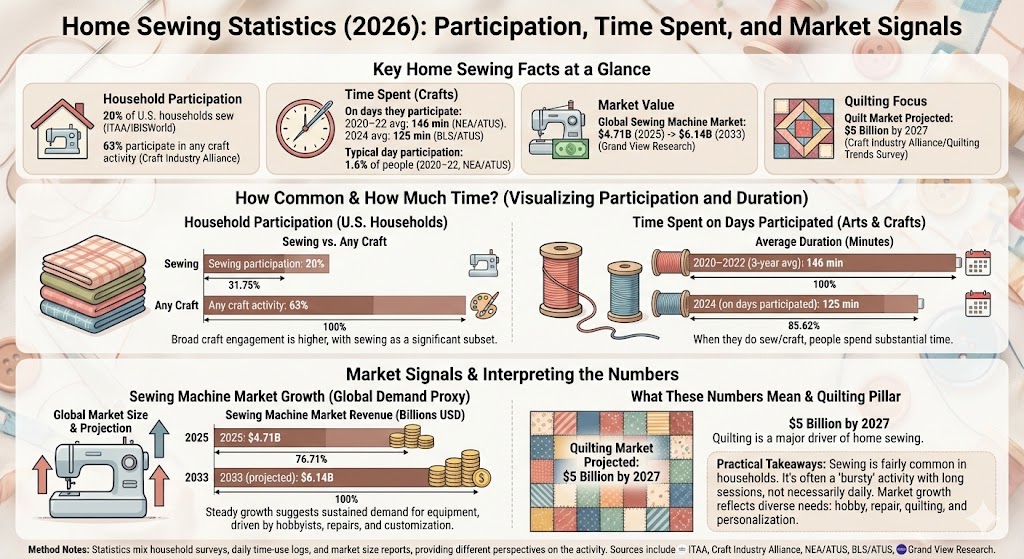
Key home sewing facts
- 20% of U.S. households participate in sewing (ITAA Proceedings; Martindale & McKinney, 2016, citing IBISWorld, 2014).
- 63% of households reported participating in at least one craft activity (Craft Industry Alliance, Jan 31, 2017; survey findings cited in article).
- In time-use data, 1.6% of people reported doing “arts and crafts as a hobby” on a typical day (National Endowment for the Arts / NASERC, Indicator B.4 report, Mar 2024; ATUS 2020–2022).
- Among people who did “arts and crafts as a hobby,” time spent was 146 minutes on a typical day (NEA / NASERC, Indicator B.4 report, Mar 2024; ATUS 2020–2022).
- In 2024, people doing “arts and crafts as a hobby” spent 125 minutes on days they engaged in the activity (U.S. Bureau of Labor Statistics, The Economics Daily, Jan 29, 2026; ATUS 2024).
- The global sewing machine market was estimated at $4.71B (2025) and projected to reach $6.14B (2033) (Grand View Research, Sewing Machine Market Report, 2033 outlook).
- A quilting industry survey summary projected the quilt market to reach $5B by 2027 (Craft Industry Alliance, May 14, 2024; Quilting Trends Survey Results 2024).
How common is home sewing?
One commonly cited benchmark for the U.S. is that about 1 in 5 households participates in sewing. Household measures are useful because sewing is often shared (a single machine, shared tools, multiple family members mending or crafting). To put sewing in context, broad craft participation rates are higher—many households do at least one craft even if they don’t sew regularly.
Source note: The 20% household sewing figure is reported in an ITAA Proceedings paper that cites an IBISWorld industry report. The 63% craft participation figure is reported in a Craft Industry Alliance article summarizing survey findings.
| Label | Bar | Value | ||
|---|---|---|---|---|
| Sewing participation (U.S. households) |
| 20% | ||
| Any craft activity (households) |
| 63% |
Max = 63%. Widths: Sewing participation (U.S. households) 31.75%, Any craft activity (households) 100.00%.
How much time do people spend when they sew or craft?
Time-use statistics help explain why sewing can feel like a “big” hobby even if not everyone does it daily. In the NEA/NASERC Indicator B.4 (ATUS-based), only 1.6% of people reported “arts and crafts as a hobby” on a typical day in 2020–2022, but those who did spent 146 minutes on that day. In a newer BLS summary for 2024, participants in arts and crafts as a hobby averaged 125 minutes on days they did the activity.
Source note: These figures are based on ATUS definitions for “arts and crafts as a hobby,” which can include multiple crafts (and may include some sewing-related activity depending on what the respondent did that day).
| Label | Bar | Value | ||
|---|---|---|---|---|
| 2020–2022 (3-year avg) |
| 146 min | ||
| 2024 (on days participated) |
| 125 min |
Max = 146 min. Widths: 2020–2022 (3-year avg) 100.00%, 2024 (on days participated) 85.62%.
Sewing machines: what the market suggests about home sewing demand
While not every sewing machine is purchased for hobby use (and market reports cover multiple segments), the overall direction of the sewing machine market is often used as a proxy signal for sustained interest in sewing, repairs, and customization. One widely cited market estimate placed the global sewing machine market at $4.71B in 2025, with projections to $6.14B by 2033.
Source note: Market-size estimates reflect the full sewing machine market (not only home users), but they are commonly referenced as a high-level demand signal for sewing-related equipment.
| Label | Bar | Value | ||
|---|---|---|---|---|
| 2025 |
| $4.71B | ||
| 2033 (projected) |
| $6.14B |
Max = $6.14B. Widths: 2025 76.71%, 2033 (projected) 100.00%.
Quilting remains a major pillar of home sewing
Quilting is often tracked separately from general sewing, but it is tightly linked to home sewing behavior (fabric buying, machine upgrades, lessons, community groups). A quilting survey summary reported that the quilt market is expected to reach $5 billion by 2027.
What these numbers usually mean in practice
- Household participation suggests sewing is fairly common (especially compared with many niche hobbies), even if it’s not “everyone’s weekly routine.”
- Typical-day participation tends to look small because sewing is often done in longer sessions, less frequently.
- Market growth in sewing machines often reflects overlapping demand: hobby sewing, garment alteration, repairs, quilting, and customization.
FAQ
How many U.S. households sew at home?
A commonly cited benchmark is that about 20% of U.S. households participate in sewing (ITAA Proceedings; Martindale & McKinney, 2016, citing IBISWorld, 2014).
Is sewing something most people do every day?
Time-use data suggest it’s not a daily activity for most people. In ATUS-based reporting, 1.6% of people did “arts and crafts as a hobby” on a typical day in 2020–2022, but those who did spent 146 minutes on that day (NEA / NASERC, Indicator B.4 report, Mar 2024). In 2024, participants averaged 125 minutes on days they did arts and crafts as a hobby (BLS, The Economics Daily, Jan 29, 2026).
Is the sewing machine market growing?
One major estimate shows growth from $4.71B (2025) to $6.14B (2033) (Grand View Research, Sewing Machine Market Report, 2033 outlook).
Method notes
These statistics mix household participation estimates, time-use measures (which report activity on a “typical day”), and market-size estimates. They answer different questions, so the best read is: sewing is fairly common across households, concentrated into longer sessions, and supported by a sizable equipment market.
Sources
- International Textile and Apparel Association (ITAA) Proceedings, 2016 (Vancouver, British Columbia): Addie Martindale & Ellen McKinney, “Why Do They Sew? A Need to Discover the Motives of Young Women to Sew Their Own Clothing” (reports: “Currently, 20% of U.S. households are participating in sewing,” citing IBISWorld, 2014).
- Craft Industry Alliance, Jan 31, 2017: “Onward and Upward! New Survey Indicates the Craft Industry is Growing in Dollars & Scope” (reports: 63% of households participated in at least one craft activity, per survey findings summarized in the article).
- National Endowment for the Arts (NEA) / NASERC, Mar 2024 (PDF): “Measuring the Arts: Indicator B.4, How Much Time Do Americans Spend on Arts Activities?” (ATUS 2020–2022; reports 1.6% participation for “arts and crafts as a hobby” on a typical day, and 146 minutes among participants).
- U.S. Bureau of Labor Statistics (BLS), The Economics Daily, Jan 29, 2026: “Baubles, bangles, and beads: time spent on hobbies” (ATUS 2024; reports 125 minutes for “arts and crafts as a hobby” among participants on days participated).
- Grand View Research: “Sewing Machine Market Size, Share | Industry Report, 2033” (reports global sewing machine market size: $4.71B in 2025; projected $6.14B by 2033).
- Craft Industry Alliance, May 14, 2024: “The Size of the Quilting Market: Quilting Trends Survey Results 2024” (reports: quilt market expected to reach $5B by 2027).